
“Virtual vs Dock-Based : Rethinking Station Design in Shared Mobility” - Meetup Summary
“Virtual vs Dock-Based : Rethinking Station Design in Shared Mobility” - Meetup Summar
December 4th, 2025 - Event
On Thursday, December 4th, 2025, the 9th edition of our meetup series was held. Check out the summary of our participants' exciting talks!
To begin with, Mathilde, public affairs officer at Qucit, presented Qucit's mission: operational intelligence for sustainable and efficient micromobility. To this end, the company is developing logistics optimization software for operators of shared micro-mobility systems to reduce their carbon footprint during their daily tasks.
In the second time, she introduced the three shared micromobility experts she was joined by to discuss Station Design in Shared Mobility and how to make bike share accessible to the greater number of people :
Marion Galan Alfonso, Head of Public Affairs for Donkey Republic
Philipp Ebert, Senior Bid & Tender Manager for Nextbike
Patrick Utz, Head of Consultancy and Research for CoMoUK
Then, Mathilde shared an historical overview of bike-sharing systems. She took us back in time, to 1965. That year, in Amsterdam, in the Netherlands, White Bikes were recycled bicycles that had been repainted and placed on the streets for anyone to use. It was a completely free-floating system, and the bikes were either kept or discarded. In 1995, in Copenhagen, in Denmark, the Caddie system was the first incentive to return and share bikes.
In 1998, in Rennes, in France, Clear Channel integrated the first computerized bike share system into its offering, requiring users to identify themselves and return the bike. Then, it was 2007 that a global trend took hold with the Vélib in Paris. In 2014, Madrid launched its dock-based e-bikeshare system.
A couple of years ago, in Italy, the number of e-bikes increased significantly, by 18% between 2023 and 2024, with 70% of these bikes part of a free-floating system. Meanwhile, within station-based systems, mechanical bikes accounted for 17% of the total, compared to 4% for e-bikes.
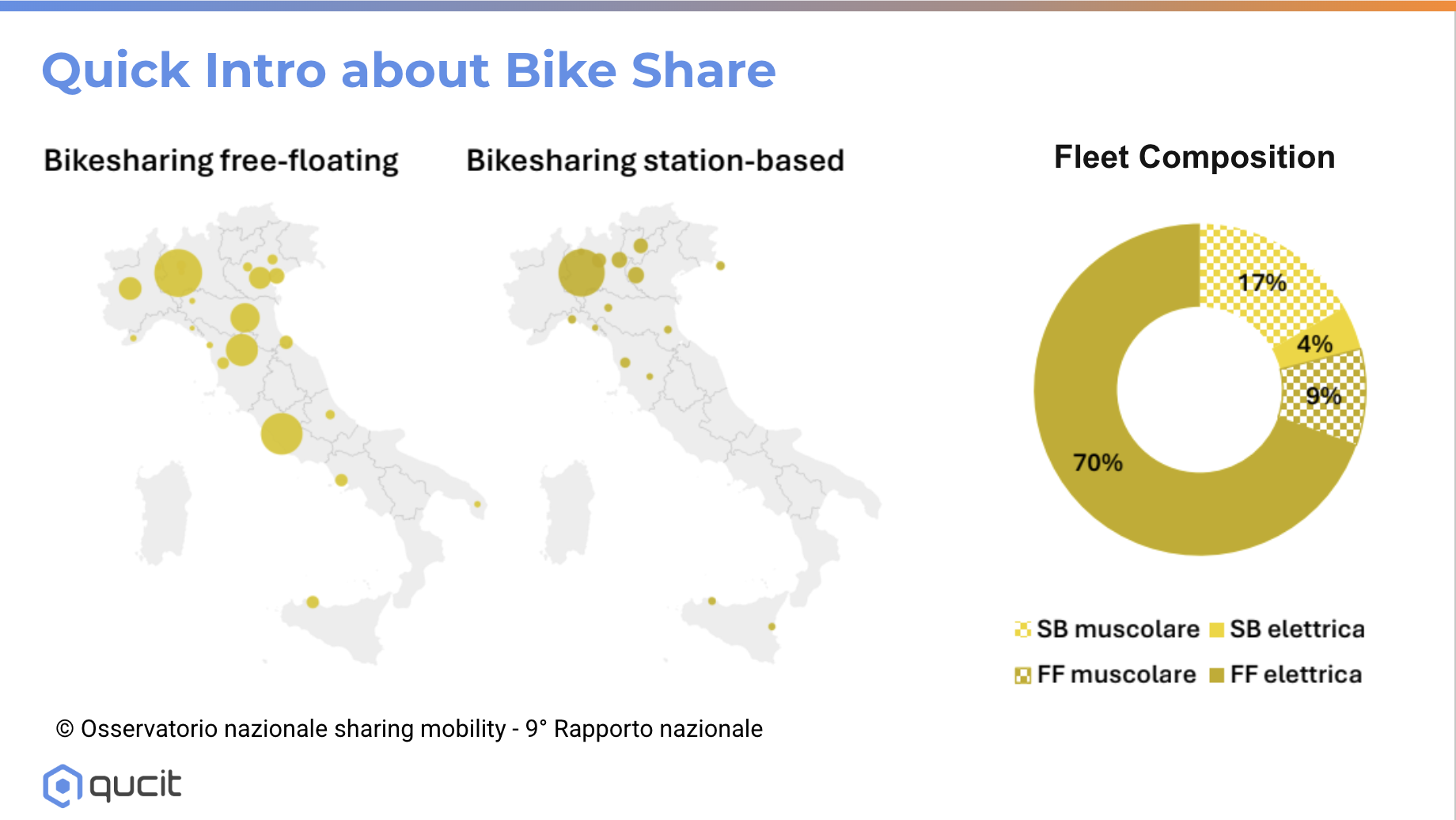
Nowadays, in Europe, around 150 European cities have a bike sharing system, totalizing a number of 438,400 shared bikes. Within that number, 61% of bikes are dock-based, and 39% are dockless, 79% are mechanical bikes while 21% are e-bikes. Finally 60% of them belong to a private bike share scheme, while 40% are part of a public one.
One thing is for sure, mobility is changing over time. With the emergence of the first bike-sharing systems, followed by today's e-bikes, stations are also evolving. One thing remains - our goal : to make micro-mobility accessible to as many people as possible. And it is with that in mind that the panel discussion started.
Firstly, Mathilde asked all the panelists to introduce, for the audience, the kind systems and technologies of shared micromobility they work with, by sharing one concrete example of a system.
Marion, Head of Public Affairs for Donkey Republic, explained that the Danish bike sharing company is present in quite a few countries in Europe. The operator mainly uses virtual stations in many European countries. Marion shared the example of the Antwerp region, in Belgium, where virtual stations are linked to public transport hubs in peri-urban and rural areas, operating both pedal and electric bikes.
Philipp, Senior Bid and Tender manager for Nextbike, said the company designs, develops, and operates schemes in around 300 cities. He added that they use station-based systems with physical docks and virtual stations with geo-fenced areas, often combining both in a hybrid system. Philipp cited the example of Cologne, which uses a hybrid system with virtual hubs in the city center and physical charging stations in the regional extent, often utilizing e-bikes with swappable batteries.
Patrick, Head of Consultancy research shared his view about his work related to station design. CoMoUK is a nonprofit organization focused on shared transport for environmental, social, and economic benefits, covering bike share, car sharing, shared e-scooters, and integration with public transport. Patrick noted that CoMoUK is funded by grants and consultancy work with public authorities, and maintains an accreditation scheme for shared micromobility operators, which helps local authorities by providing quality standards during the procurement of services.
Philipp emphasized the importance of city landscape, user needs, and topography, which often determines the necessity of e-bikes or mechanical bikes. Philipp further detailed that analysis should include demographics, social surroundings, commuting flows, and existing public transport networks to align and complement services. Marion brought up the public budget and investment cost, noting that systems with charging stations require high investment and long contract lengths to be financially viable, making hybrid systems often a favorable solution for cities with constrained budgets. Patrick added that extending the scope to include free-floating options and designated parking areas outside of physical or virtual stations is crucial, particularly for last-mile commuting in less densely populated areas.
Patrick noted a strong trend towards e-bikes, as people are willing to pay more for them, leading to a higher return on investment compared to pedal bikes. Philipp agreed, observing that fleets are becoming more electrified, especially in cities with prior bike-sharing experience, to cover longer trips and connect the outskirts. Philipp stated that operating an electrified fleet requires ensuring bikes are always charged, making swappable batteries essential and strategically placed charging stations valuable for lowering operational efforts in high-usage areas. Marion added that the characteristics of the e-bike, such as battery power and swapping frequency, are crucial considerations depending on the type of station selected for a city or region.
Philipp discussed the investment required for physical infrastructure, noting that costs include not only the physical setup but also marketing and advertising to establish the system. Philipp asserted that physical infrastructure is a visible element in the urban landscape, demonstrating its role as an essential part of public transport, and argued that long-term contracts can lead to a break-even point where increased usage and revenue justify the initial investment, especially with physical stations reducing operational efforts for e-bike systems. Marion nuanced this by mentioning that virtual stations, particularly for pedal bikes, can utilize existing bike racks or easily implemented parking spots with paint and signage, offering a much lower-cost investment and greater flexibility for dense networks, while maintaining visibility.
Marion pointed out that docking and charging stations present flexibility issues, particularly during peak commuter flow, leading to tension and increased costs in the rebalancing process, which can negate the CO2 gains of a bike-sharing system due to heavy rebalancing movements. For virtual stations, the main challenge is the need for more frequent battery swaps, making e-bike battery characteristics critical for operational cost efficiency. Philipp emphasized that physical stations offer a key advantage in reducing vandalism and theft rates because the bikes are securely parked. Philipp also noted that virtual stations excel at enabling fast, dense network deployment and providing flexibility for high-demand events like football matches or Olympia.
Patrick highlighted the lack of a national or regional policy in the UK, which creates fragmentation, such as in London where 32 different municipalities have varying rules for shared transport. Patrick mentioned that the upcoming fundamental reorganization of local government in England will introduce a licensing scheme for shared micromobility, expected to streamline management and expand usage. Patrick strongly asserted that the fundamental priority for local authorities must be investment in safe cycling infrastructure, noting a significant gap in the UK compared to other Western European countries, as this is necessary to encourage new user groups.
Marion shared that vandalism rates vary across cities and that in places where it is an issue, making it mandatory to chain the bike to the virtual station rack is effective, similar to a docking system but with added flexibility. Marion added that technology like alarms is integrated directly into the bikes to deter theft. Philipp agreed and added that technology, such as sensors, helps recognize abnormal activity immediately, and promoting the concept of bikes as a "common good" through user communication can also raise awareness and help prevent vandalism.
Philipp stated that infrastructure can offer security against theft and vandalism, though non-technological issues involving single individuals still arise and need rapid attention in cooperation with local authorities. Patrick discussed the tension in digital service management regarding user threshold for shared bikes; keeping the threshold low, potentially with a tap on/tap off system, might compromise the ability of operators and authorities to track users. Conversely, requiring users to register a driving license, as in England for e-scooters, allows police to track renters but raises the threshold for usage and reduces the potential user base, as some people do not have a driving license.
Philipp selected access reliability and availability of bikes, which they said combines various system aspects such as the probability of a user finding a bike. He explained that low access reliability can indicate insufficient station density, suggesting a need to densify the network beyond 500 meters per station to perhaps every 200 or 300 meters. Marion agreed that this is very linked to a heat map dashboard shared with clients, which shows when users cannot find a bike, helping to set up new stations or rebalance existing ones. They also, both emphasized that a second KPI should align with the municipality's goal, such as increasing the modal shift to biking and public transport, which requires surveys and measuring progress toward that outcome
Finally, following the presentations of our 3 experts, we have taken the time to answer your questions.
Dear readers, we are delighted to have counted you among our audience and hope that this webinar has provided you with a wealth of new knowledge.
Our warmest thanks once again to our speakers: Marion, Philipp and Patrick for taking part and sharing their expertise.
See you soon for another webinar on shared micromobility!